
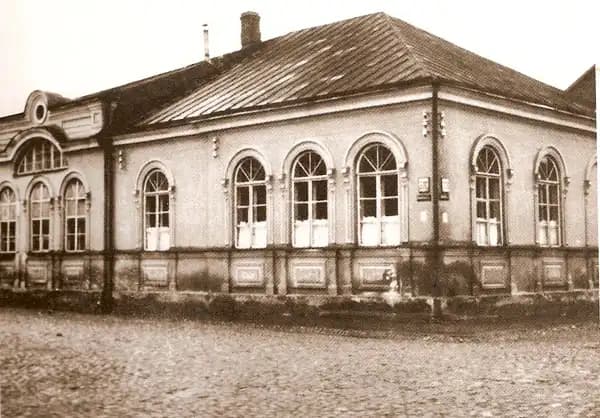
We're continuing to digitize and index Rootera's main historical dataset — the first general census of the Russian Empire, taken in 1897, for Daugavpils (Dvinsk).
Processing another large batch of archival pages added more than 77,000 new records to the database. The total number of indexed rows from the Dvinsk census in the system has now reached 257,288.
But behind these numbers are more than rows in a database.
These are families who lived in Dvinsk more than 120 years ago: artisans, merchants, workers, railwaymen, soldiers, officials, and members of the city's many communities.
For many present-day residents of Latvia, as well as descendants of Dvinsk's Jewish families now living in Israel, the United States, Canada, and elsewhere, these records are a chance to reconnect with a city that often survives only in family stories.
Dvinsk at the turn of the century: a city where worlds met
In 1897, Dvinsk was one of the most dynamically growing cities in the western part of the Russian Empire.
Several factors drove its growth:
- its location on the Western Dvina (Daugava) river;
- vigorous trade and craft production;
- the expansion of the railway network;
- the presence of the Dvinsk Fortress;
- a large and economically active Jewish community.
The city stood at the crossroads of cultures and traditions. Jews, Latvians, Russians, Poles, Germans, and members of other peoples all lived here.
Dvinsk was at once a trading town, an industrial center, a railway hub, and a military post.
That combination shows directly in the structure of its population.
What was an "estate," and why does it matter for genealogy?
When working with documents from the Russian Empire, it helps to understand that a social estate (soslovie) was not simply a social status in the modern sense.
It was an official legal category that could persist across generations.
For example:
- a townsman (meshchanin) could be an artisan, a trader, or the owner of a house or small business;
- a peasant could live in a city and work on the railway, in a factory, or in a workshop;
- a nobleman could serve as an army officer, an official, or a clerk.
So a record reading "peasant" doesn't automatically mean rural origin, and a record reading "townsperson" doesn't mean poverty.
For genealogy, an estate is an extra clue about a family's origin, its standing, and where to search next.
For more on what else the 1897 census can reveal — from social estate to native language and literacy — see our guide to searching ancestors.
Dvinsk's social portrait in the 1897 census
- Townspeople56.4%
- Peasants34.5%
- Nobility4.9%
- Other estates4.2%
Townspeople: the backbone of city life
The largest group in the population was the townspeople (meshchane).
The census recorded 42,662 people — 56.4% of the population.
This fits Dvinsk's character as a major urban center.
Townspeople made up the fabric of everyday city life:
- artisans;
- small traders;
- workshop owners;
- homeowners;
- clerks and employees;
- members of various urban professions.
The city's Jewish community mattered enormously for this category.
In the Russian Empire, most of the urban Jewish population was legally registered as townspeople. That's why the high share of townspeople is directly tied to Dvinsk's role as one of the region's important centers of Jewish life.
That said, townspeople were not exclusively a Jewish estate. The category included people of many backgrounds and faiths — Jews, Russians, Poles, Latvians, and other city residents.
Peasants in the city: why were there so many?
One of the most interesting findings is the sheer number of residents recorded with peasant status.
Together, the various peasant categories add up to 26,098 people — 34.5% of the population (manor peasants, state peasants, and peasants with unspecified category combined).
At first glance, it might seem strange that a third of residents in a large city were registered as peasants.
But in the Russian Empire, moving to a city did not automatically change a person's legal estate.
Many Dvinsk residents worked on the railway, at factories, in a trade, or served in the fortress — while remaining legally peasants.
For genealogical research, this matters a great deal: a city address in a document and peasant status could easily coexist.
Nobility and the fortress city
The noble estate accounted for 3,721 people — 4.9%.
For a city this size, that's a relatively high share.
One reason was the military presence in the city.
The Dvinsk Fortress (the Dinaburg Fortress before 1893) was one of the city's military installations. The city was home to:
- military units;
- the officer corps;
- state institutions;
- officials;
- administrative services.
The fortress's presence shaped a distinct layer of the population that set Dvinsk apart from many other cities in the region.
Merchants and the city's trading economy
The census registered 1,397 merchants — 1.8%.
Although the merchant estate was relatively small, its role in the city's economy far outweighed its numbers.
Merchants were active in trade, transport, supply, and industrial development.
It's worth noting: not every trader was legally a merchant. Many shop owners, small entrepreneurs, and craftspeople were registered as townspeople.
The growth of the railways made Dvinsk one of the region's most important transport hubs and fueled the growth of its urban economy.
From an archive row to a world-famous story: the Rothkowitz family
Perhaps the most interesting thing about data like this isn't the statistics themselves.
It's that ordinary census sheets sometimes hide the stories of families who would later become known around the world.
One such example is the Rothkowitz family of Dvinsk.
You won't find Markus Rothkowitz himself in the 1897 census — the future painter Mark Rothko — because he wasn't born until 1903.
But you can find his family's generation, and the environment his family lived in.
The Rothkowitzes were part of that same late-19th and early-20th-century Dvinsk: a city of townspeople, traders, artisans, and countless Jewish families.
A few years after Markus was born, the family emigrated to the United States. There he became one of the most influential painters of the 20th century and one of the leading figures of abstract expressionism.
Today, Mark Rothko's paintings hang in the world's major museums.
But before that, there was an ordinary family from Dvinsk.
Stories like this show the real value of archival data. A census isn't just a list of surnames. It's a chance to see people before their fates became famous.
On Rootera, you can search for more than famous names. What matters far more is recovering the stories of thousands of ordinary families who were part of this city.
Estate composition of Dvinsk, 1897 census
| Estate | Records | Share |
|---|---|---|
| Townspeople | 42,662 | 56.4% |
| Peasants | 26,098 | 34.5% |
| Nobility | 3,721 | 4.9% |
| Merchants | 1,397 | 1.8% |
| Military | 564 | 0.7% |
| Honored citizens | 430 | 0.6% |
| Settlers | 384 | 0.5% |
| Officials | 173 | 0.2% |
| Foreign subjects | 169 | 0.2% |
| Clergy | 95 | 0.1% |
Why this data matters today
For genealogists, the value of a dataset like this isn't only about finding a surname.
Context helps you understand what you find.
For example:
- townsperson status can point to a family's urban origin;
- peasant status doesn't rule out life in a city;
- a military record can explain why a family ended up in Dvinsk;
- an estate can point you toward the right next steps in your search.
This matters especially for descendants of Dvinsk families who are today trying to reconstruct their ancestors' history from a single name, an old photograph, or a family legend.
Behind every record is more than a person from the past. Behind it is a family.
A note on data accuracy
The figures presented here are based on the processing and indexing of archival material from the 1897 Imperial Russian census.
Like any historical source, this data may contain occasional inaccuracies: enumerator errors, quirks of how documents were filled in, variation in the spelling of names and surnames, and errors introduced by automated processing and indexing.
The figures should therefore be read as the closest possible reconstruction of the population's structure based on the available data.
Despite any individual discrepancies, the overall proportions and social structure closely match the historical context of late-19th-century Dvinsk.
The updated data is now available for search on Rootera. The system supports surname search in both Cyrillic and Latin script, helping researchers and descendants of Dvinsk families find their ancestors in documents more than a century old.
For more on how that search works, and what to try if a surname doesn't turn up right away, see our guide to searching ancestors in the 1897 census.