
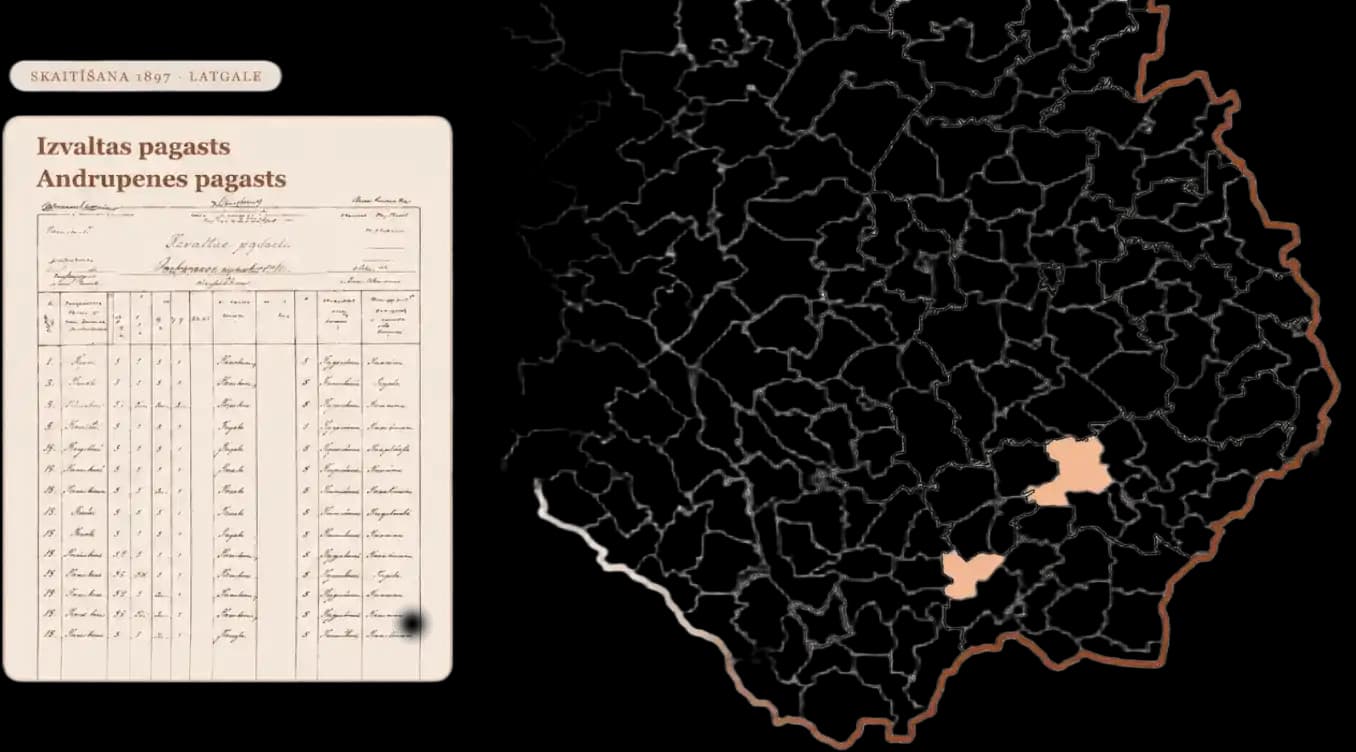
When you're searching the archive by hand, you're usually locked onto one person and one record set at a time — a name, a surname, a parish, and you page through sheet after sheet. But once that data lives in a proper database, you can zoom out and look at the structure of entire regions. Now that Rootera has indexed tens of thousands of 1897 census sheets for Latgale, it's possible to compare datasets side by side — and some of what turned up surprised me.
For this analysis I picked two parishes — Andrupene and Izvalta. They don't share a border, but they sit in the same region and the same era, and both were largely rural. You'd expect similar villages with similar histories. Instead, the automated analysis turned up striking differences — in both surname distribution and social makeup.
Surname "handwriting"
The first thing that jumps out when you compare the two parishes is how differently their surnames are distributed.
In Andrupene parish, surname diversity is enormous: the most common names don't dominate — they're only slightly ahead of everyone else.
| # | Surname | Count |
|---|---|---|
| 1 | Gribust | 120 |
| 2 | Stepen | 120 |
| 3 | Munda | 112 |
| 4 | Platach | 108 |
| 5 | Bogdanov | 105 |
| 6 | Grabovsky | 98 |
| 7 | Babra | 97 |
| 8 | Zunda | 94 |
| 9 | Shalaev | 87 |
| 10 | Stykut | 78 |
| 11 | Rukman | 78 |
| 12 | Burtsov | 76 |
| 13 | Beitan | 76 |
| 14 | Zaremba | 74 |
| 15 | Tuch | 64 |
| 16 | Laizan | 61 |
| 17 | Rokol | 59 |
| 18 | Vishnevsky | 55 |
| 19 | Rynkevich | 50 |
| 20 | Butler | 47 |
The surname map of this parish looks like a patchwork quilt: the top two names, Gribust and Stepen, show up only 120 times each, followed by a long tail of surnames that appear far less often.
Izvalta parish tells a completely different story. Here, a handful of family lines are enormous.
| # | Surname | Count |
|---|---|---|
| 1 | Dzalba | 440 |
| 2 | Stepen | 311 |
| 3 | Yakovel | 291 |
| 4 | Vigul | 255 |
| 5 | Styvrin | 243 |
| 6 | Peipin | 235 |
| 7 | Ostrovsky | 211 |
| 8 | Kudin | 191 |
| 9 | Lipshan | 183 |
| 10 | Umbrashko | 170 |
| 11 | Brench | 162 |
| 12 | Krivin | 148 |
| 13 | Lipin | 146 |
| 14 | Cherpinsky | 144 |
| 15 | Sargun | 140 |
| 16 | Bogdanov | 139 |
| 17 | Tselitan | 125 |
| 18 | Suveizda | 118 |
| 19 | Ivanov | 116 |
| 20 | Yapin | 110 |
These aren't just "common surnames" — the numbers point to large family lines that grew across several generations within the same territory. Dzalba: 440 people. Styvrin: 243. Kudin: 191. Even the twentieth name on the list, Yapin with 110 records, comes close in raw numbers to the leader in Andrupene. There's no long tail of rare surnames here — instead, a dense core of a few dozen large family lines.
Which raises an obvious question: why would two neighboring rural parishes in the same region look so different in their surname "handwriting"?
The social cross-section holds the answer
Estate statistics provide it — and this is really the core insight of the whole analysis.
| Estate | Andrupene | Izvalta |
|---|---|---|
| State peasants | 13.1% | 70.4% |
| Manor peasants | 43.3% | 0.7% |
| Other peasants | 27.3% | 27.9% |
| Townspeople | 14.7% | 0.9% |
| Nobility | 1.7% | 0.1% |
Izvalta parish is an almost solid block of state peasants: 70.4% of residents are recorded as "peasant, state-owned" or some variant of it. So what's behind that number?
Crown land was a different world. There was no landlord who could sell off a village, resettle families, or divide an estate among heirs. Generation after generation, the same surnames lived on the same land, married in the same parish church, and had their children baptized by the same priests. Centuries of staying put — that's what these figures reflect. The Styvrins, the Kudins, the Viguls aren't a coincidence; they're the result of many generations rooted in one place.
In the 19th century, that settledness reached its extreme form: the region's villages were transferred from civilian to military administration and turned into military settlements of "plowman-soldiers." Among the settlers were Russian Old Believers who had lived in the area for generations, alongside local Latgalian peasants. The military settlements didn't create this rootedness — they froze it in place: leaving or relocating became even harder. When the settlements were eventually disbanded, people simply carried on living where their grandparents had.
Andrupene parish is the exact opposite. Manor landownership ruled here: nearly half the residents were manor peasants — former serfs. Estates were split up, sold, and their peasants shuffled around at the whim of new owners. Almost 15% were townspeople, unusually high for a rural parish — this reflects szlachta reclassified as townspeople after the reforms, along with settlers from the Smolensk, Vilna, and Vitebsk governorates. Hence Zaremba and Vishnevsky, Bogdanov and Burtsov, Munda and Zunda, all sharing the same parish, all on the same census sheet.
Bridges between two worlds
Despite the stark contrast, there are points of overlap between the two parishes — and those are especially interesting for genealogists.
Take the surname Bogdanov: 105 people in Andrupene, 139 in Izvalta. Or Stepen — 120 versus 311. That's unlikely to be pure coincidence; it's more likely a trace of real family movement between the two territories.
Important: sharing a surname does not necessarily mean that people were related. The surname Bogdanov, for example—literally “given by God”—could be assigned to children born outside marriage or taken in by another family. The Fedoseevtsy rejected marriage and, consequently, the possibility of legitimate childbirth. One way to raise children while remaining within the community may have been to take in an infant presented as having been found or abandoned: the child would be baptized, given a name and surname—including Bogdanov—and raised by the family. These surname matches are therefore not proof of kinship, but an example of what the system can reveal: potential links between places that must then be checked against original archival sources.
Rootera calls this tool Connection Explorer — read more about how to use it in our guide to searching ancestors in the 1897 census.
This is exactly where a digital database changes the game. In the past, you'd only stumble onto a connection like this by chance, after paging through thousands of pages across two separate record sets. Now it's a single query.
What this means in practice
A single paper record in the archive only shows you one family. A digital database lets you change the lens and see the context around it — social, demographic, geographic.
I put this quick analysis of two parishes together in a single evening. Doing it by hand, paging through archival files, would have taken months. And the numbers immediately reshape your search strategy: if my ancestor in Latgale was a townsman, it makes sense to look in Andrupene parish — searching Izvalta would be nearly pointless, since townspeople make up less than 1% of it there. Estate statistics let you rule out dead ends right away and focus on the places someone could plausibly have ended up.
Of course, I'm looking at these charts first as a data analyst, not a professional historian. The raw numbers reveal an anomaly and a striking correlation, but behind them lie complex historical processes that still deserve a much closer look.